Posted by: Muhammad Asad Ishaq (Rise and Fall of Blackberry)
Rise and Fall of BlackBerry – A Corporate Lesson.
Introduction
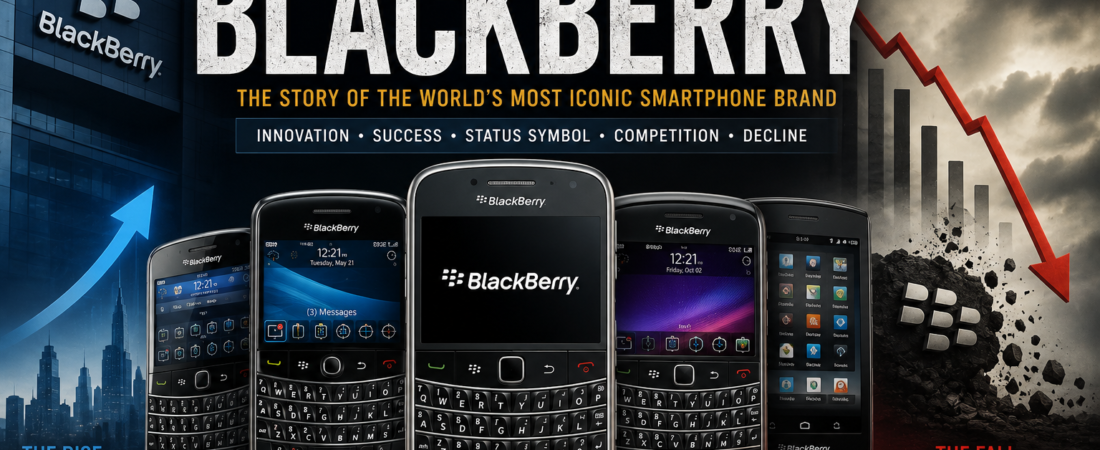
The story of BlackBerry is one of the most remarkable business stories in the technology industry. The company transformed mobile communication and became the preferred smartphone brand for business professionals, politicians, and world leaders. At its peak, owning a BlackBerry was a symbol of success and professionalism. However, despite its early achievements, the company failed to keep pace with changing consumer preferences and rapid technological innovation. As a result, BlackBerry lost its leadership position in the smartphone market.
This article explores the history, growth, success, and eventual decline of BlackBerry. It also explains why millions of people preferred the brand and what mistakes ultimately led to its fall.
The Origin of BlackBerry
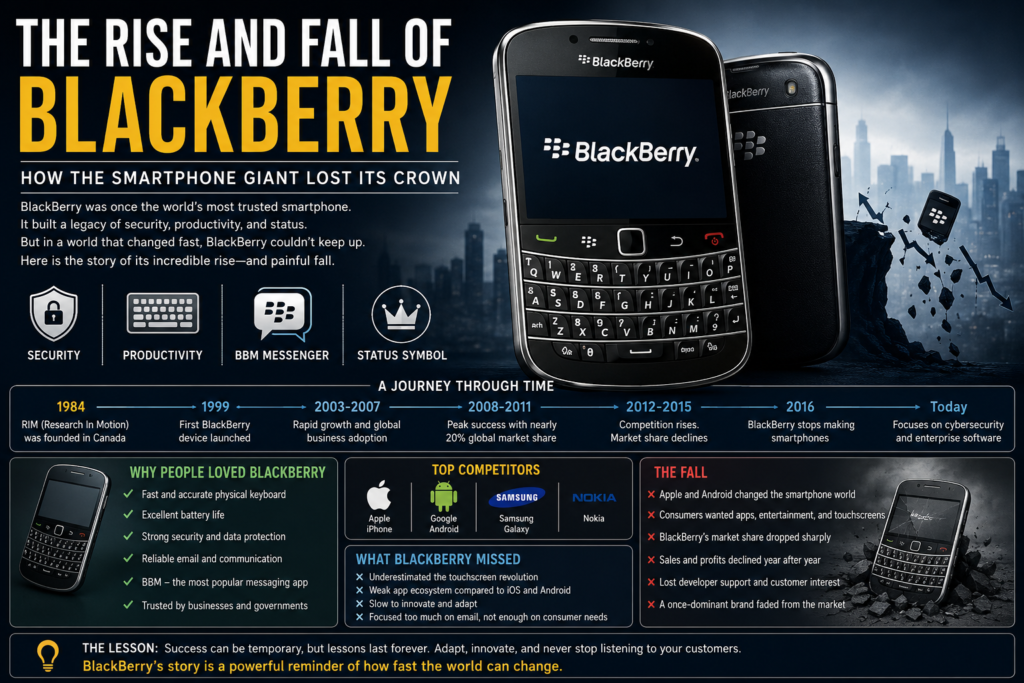
BlackBerry was developed by Research In Motion (RIM), a Canadian technology company founded in 1984 by Mike Lazaridis and Douglas Fregin. Initially, the company focused on wireless communication technologies rather than smartphones.
In 1999, RIM introduced the first BlackBerry device. It was mainly designed for email communication. Although it was not a traditional smartphone, it quickly gained popularity among corporate users because it allowed secure and instant access to emails.
Soon afterward, BlackBerry expanded its product line and introduced smartphones with calling, messaging, internet browsing, and productivity features.
The Rise of BlackBerry
BlackBerry experienced rapid growth during the early 2000s. Businesses, government agencies, and multinational corporations adopted BlackBerry devices because they offered reliable communication and industry-leading security.
The company’s smartphones featured physical QWERTY keyboards, which made typing emails fast and comfortable. Moreover, battery life was excellent compared to many competing devices.
Consequently, BlackBerry became the preferred choice for executives, lawyers, bankers, journalists, and government officials.
BlackBerry Became a Status Symbol
At its peak, owning a BlackBerry represented professionalism and success. Many CEOs, senior executives, and politicians carried BlackBerry devices because they could remain connected wherever they traveled.
The device earned the nickname “CrackBerry” because users became addicted to checking emails and messages throughout the day.
Even former U.S. President Barack Obama continued using a BlackBerry after taking office because of its trusted security features.
As a result, BlackBerry was widely recognized as the smartphone for serious professionals.
Why People Preferred BlackBerry
Several features made BlackBerry unique.
First, the physical keyboard provided fast and accurate typing. Many users preferred real keys over touchscreen keyboards.
Second, BlackBerry offered excellent battery life. Users could often work for an entire day without charging the phone.
Third, the devices were highly secure. The company’s encrypted communication system protected emails and business data from unauthorized access.
Furthermore, BlackBerry Messenger (BBM) became one of the world’s first popular instant messaging services. BBM allowed users to exchange messages securely and instantly without paying SMS charges.
In addition, BlackBerry devices were durable, reliable, and simple to use. Therefore, many professionals remained loyal to the brand for years.
Market Share and Financial Success
BlackBerry reached its highest level of success between 2007 and 2011.
During this period, the company controlled nearly 20% of the global smartphone market, making it one of the world’s leading smartphone manufacturers.
Millions of BlackBerry smartphones were sold every year. The company generated billions of dollars in annual revenue and earned strong profits from hardware sales, software services, and enterprise solutions.
Its market value also increased significantly, making Research In Motion one of Canada’s most valuable technology companies.
The rapid growth demonstrated how powerful the BlackBerry brand had become.
BlackBerry’s Competitors
Although BlackBerry dominated the business smartphone market, competition increased rapidly.
Major competitors included:
- Apple
- Samsung
- Nokia
- HTC
- Motorola
- Sony Ericsson
- LG
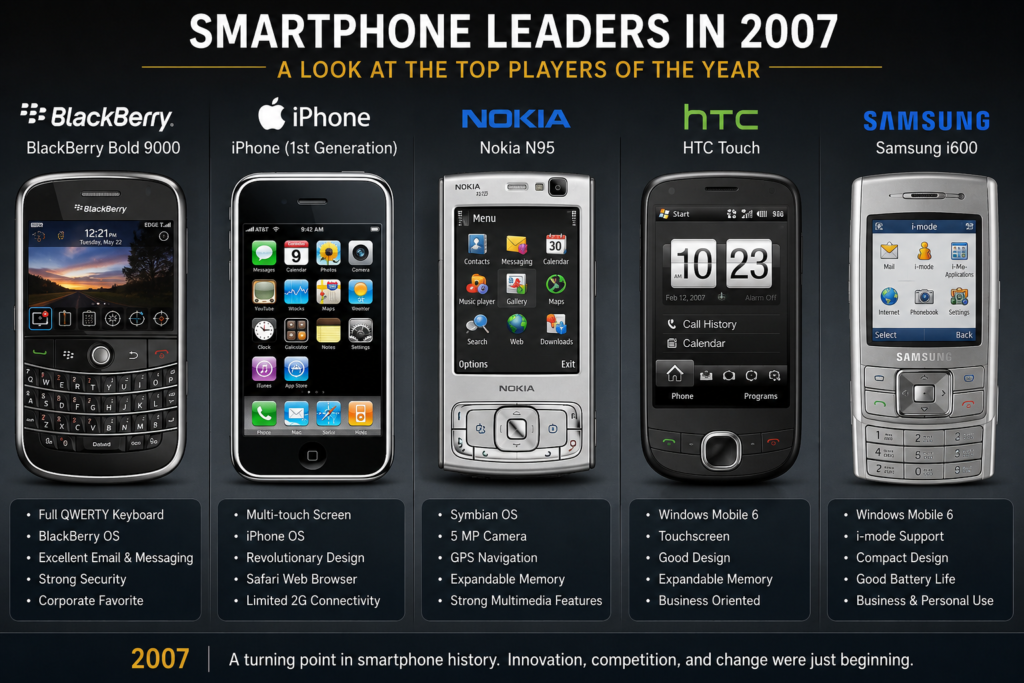
Initially, BlackBerry remained ahead because of its secure email system and physical keyboard. However, the smartphone industry changed dramatically after Apple introduced the iPhone in 2007.
Soon afterward, Google’s Android operating system allowed companies such as Samsung and HTC to produce powerful touchscreen smartphones.
Consequently, customer expectations changed across the world.
The Smartphone Revolution
The launch of the iPhone completely transformed the smartphone industry.
Instead of focusing only on email and communication, Apple introduced a device centered on apps, multimedia, internet browsing, photography, and entertainment.
Google followed with Android, which quickly attracted many smartphone manufacturers.
Consumers now wanted larger touchscreens, powerful cameras, mobile games, social media, navigation, and millions of downloadable apps.
Unfortunately, BlackBerry continued focusing mainly on business users.
Although the company introduced touchscreen devices later, it reacted much more slowly than its competitors.
What BlackBerry Missed
BlackBerry made several strategic mistakes.
First, the company underestimated the importance of touchscreen technology. Executives believed customers would always prefer physical keyboards.
Second, BlackBerry failed to build a competitive app ecosystem. While Apple’s App Store and Google Play Store expanded rapidly, BlackBerry World offered far fewer applications. Consequently, developers focused their efforts on iOS and Android.
Third, BlackBerry responded slowly to changing consumer behavior. Users wanted smartphones for photography, gaming, streaming, and social media. However, BlackBerry continued emphasizing email and business productivity.
Moreover, the company released several products that failed to compete effectively with newer smartphones.
These decisions gradually reduced customer confidence.
The Fall of BlackBerry
After 2011, BlackBerry’s decline accelerated.
Apple and Samsung introduced more advanced smartphones every year. Their devices featured better cameras, larger displays, faster processors, and thousands of applications.
Meanwhile, Android smartphones became available at different price ranges. Therefore, consumers had many more choices.
BlackBerry’s market share declined sharply. Sales continued falling, and profits disappeared.
The company launched the BlackBerry 10 operating system in an attempt to recover. However, the effort came too late. Most developers had already committed to Android and iOS.
As a result, BlackBerry could no longer compete in the smartphone market.
Eventually, the company stopped designing its own smartphones and shifted its focus toward cybersecurity, enterprise software, and secure communication solutions.
Lessons from BlackBerry’s Story
BlackBerry’s journey offers valuable lessons for entrepreneurs, business leaders, and investors.
First, success today does not guarantee success tomorrow. Every company must continue innovating.
Second, businesses should always listen to changing customer needs. Consumer preferences can evolve quickly.
Third, technology companies must build strong ecosystems, not just excellent products. Apps, software, and developer support are equally important.
Furthermore, companies should be willing to challenge their own successful products before competitors do.
Finally, leaders should recognize market trends early and respond quickly.
Conclusion
BlackBerry changed the smartphone industry forever. It introduced secure mobile communication and helped professionals stay connected anywhere in the world. Moreover, its reliable keyboards, strong security, and business-focused features made it one of the most respected smartphone brands in history.
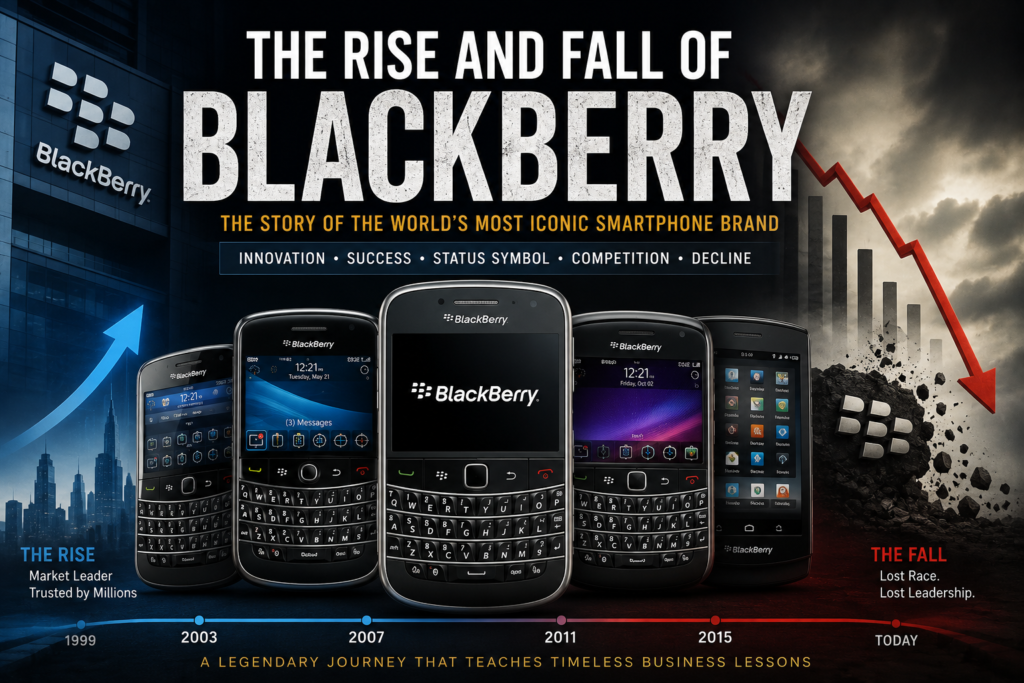
However, the company failed to adapt to changing technology and consumer expectations. While Apple and Android embraced touchscreens, app ecosystems, multimedia, and continuous innovation, BlackBerry remained focused on its traditional strengths. Consequently, it lost market share, revenue, and customer loyalty.
Today, BlackBerry no longer leads the smartphone market. Instead, it has successfully reinvented itself as a cybersecurity and enterprise software company. Nevertheless, its rise and fall remain one of the greatest business case studies of all time. The story reminds every organization that innovation, adaptability, and customer focus are essential for long-term success.
For more articles related to corporates please visit: Article Section.